
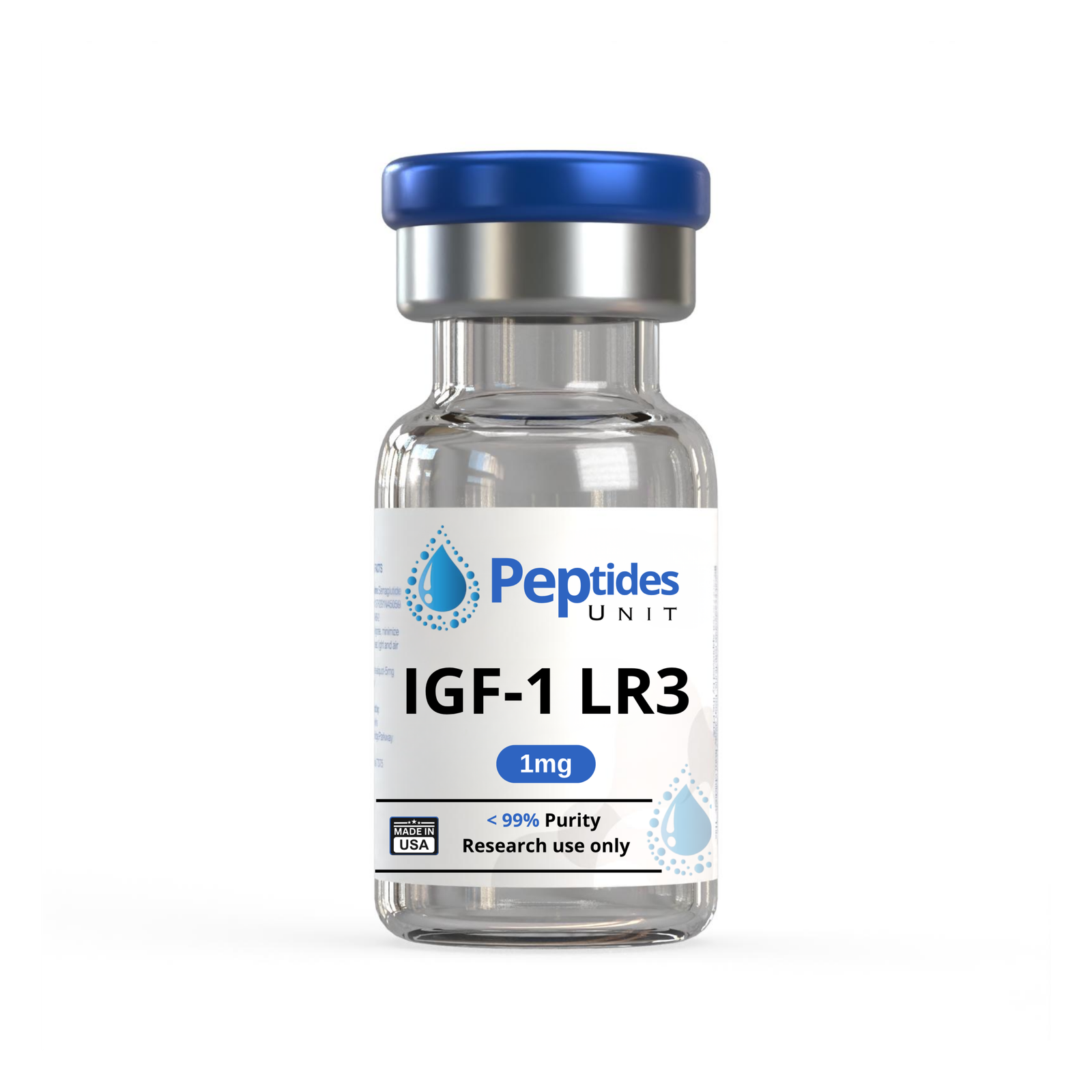
IGF-1 LR3 Peptide (Insulin-like Growth Factor-1 Long Arg3) – Research Grade
IGF-1 LR3 (Long Arginine 3 IGF-1) is a synthetic, 83-amino acid analog of human insulin-like growth factor-1 (IGF-1) engineered for enhanced biological stability and potency . The structure incorporates a glutamic acid-to-arginine substitution at position 3 (hence “R3”) and a 13-amino acid N-terminal extension peptide . This modification reduces the analog’s affinity for IGF-binding proteins (IGFBPs) by over 100-fold compared to native IGF-1, dramatically prolonging its half-life and bioavailability in vitro . With a half-life of approximately 20–30 hours, IGF-1 LR3 is significantly more potent than the regular IGF-1 base .
IGF-1 LR3 functions primarily through binding to the IGF-1 receptor (IGF1R), activating the PI3K/AKT and MAPK signaling pathways that stimulate cell growth, proliferation, and survival while inhibiting apoptosis . Research has explored its applications in diverse areas, including mammalian cell culture, neuroprotection, and Alzheimer’s disease research .
⚠️ Research Context: This product is intended exclusively for in-vitro and laboratory research purposes. It is not approved by the FDA for human use. All sources confirm: “FOR RESEARCH, LABORATORY AND MANUFACTURE USE ONLY. NOT INTENDED FOR DIRECT USE ON HUMANS” .
Mechanism of Action
IGF-1 LR3 functions as a highly potent ligand for the IGF-1 receptor (IGF1R) :
Enhanced Bioavailability:
-
The arginine substitution at position 3 and N-terminal extension dramatically reduce binding to IGF-binding proteins (IGFBPs)
-
Free from the regulatory constraints of binding proteins, the analog remains active up to 120 times longer than standard IGF-1
Receptor Activation & Signaling:
-
Binds to the IGF1R alpha subunit, activating intrinsic tyrosine kinase activity and autophosphorylation of tyrosine residues in the beta subunit
-
Triggers downstream activation of the PI3K-AKT/PKB and Ras-MAPK signaling cascades
-
Stimulates cellular proliferation, differentiation, and protein synthesis
Metabolic Effects:
-
Promotes glucose uptake and glycogen synthesis in bone-derived cells
-
Regulates fat metabolism and can stimulate lipolysis
Key Research Applications:
-
Cell culture supplementation (serum-free or low-serum systems)
-
Cellular growth, proliferation, and differentiation studies
-
Signal transduction research (PI3K/AKT, MAPK pathways)
-
Protein synthesis and muscle cell hypertrophy assays
-
Neuroprotection and Alzheimer’s disease research
Product Specifications
| Parameter | Specification |
|---|---|
| Product Name | IGF-1 LR3 (Long R3 IGF-1) |
| Synonyms | Long R3 IGF-1, LR3-IGF-I, rhIGF-1 LR3, Long Arginine 3 IGF-1 |
| CAS Number | 946870-92-4 |
| Molecular Weight | ~9.1 kDa |
| Sequence Length | 83 Amino Acids |
| Sequence (One Letter) | MFPAMPLSSL FVNGPRTLCG AELVDALQFV CGDRGFYFNK PTGYGSSSRR APQTGIVDEC CFRSCDLRRL EMYCAPLKPA KSA |
| Purity | >95% (SDS-PAGE) |
| Appearance | White lyophilized powder |
| Endotoxin Level | <0.1 EU/µg |
| Biological Activity (ED50) | 0.38–6 ng/mL in MCF-7 cell proliferation assay |
| Half-Life | ~20–30 hours |
| Storage | -20°C (long-term); after reconstitution: 4°C for 1 week, -20°C with carrier protein |
| Solubility | Reconstitute at 100–200 µg/mL in sterile water; further dilutions in aqueous buffers |
Quality Assurance
Every batch of IGF-1 LR3 undergoes rigorous analytical testing:
| Test | Method | Specification |
|---|---|---|
| Identity | SDS-PAGE / Mass Spec | Matches 9.1 kDa molecular weight |
| Purity | SDS-PAGE | >95% |
| Biological Activity | MCF-7 Cell Proliferation Assay | ED50 < 6 ng/mL |
| Endotoxin | LAL Test | <0.1 EU/µg |
Certificate of Analysis (COA) available upon request.
Research Background
Structural Engineering & Enhanced Activity
IGF-1 LR3 was specifically engineered to overcome the limitations of native IGF-1 in research applications. Natural IGF-1 binds strongly to a family of IGF-binding proteins (IGFBPs) that regulate its bioavailability. By substituting arginine for glutamic acid at position 3 and adding an N-terminal extension, the LR3 analog exhibits >100-fold reduced affinity for IGFBPs, making it an ideal choice for studies requiring sustained receptor engagement . The analog’s enhanced half-life (20–30 hours) and increased activity—estimated up to 120 times longer than standard IGF-1 —allow for reduced dosing frequency in cell culture models.
Key Research Findings
Neuroprotection & Alzheimer’s Disease (2024):
A 2024 study published in the Journal of Alzheimer’s Disease investigated intranasal LR3-IGF-1 treatment in male 5XFAD mice over 7 months. The treatment improved body composition and promoted favorable effects on Aβ plaque remodeling in the cortex, including a reduction in filamentous plaques and low molecular weight Aβ oligomers. In vitro, LR3 enhanced Aβ uptake by BV2 microglial cells and promoted gene pathways involved in actin remodeling and endocytosis. However, the study concluded that LR3 as a monotherapy failed to preserve cognitive function, suggesting that combinatorial formulations may be required .
Cell Culture Supplementation:
IGF-1 LR3 is widely adopted as a supplement in serum-free or low-serum cell culture systems to support cell viability, proliferation, and differentiation . Its prolonged activity and reduced degradation make it a reliable alternative to native IGF-1 for maintaining optimal cellular function over extended experimental timelines .
Signal Transduction:
The peptide is frequently employed to probe intracellular pathways involved in metabolism, apoptosis, and gene expression, offering insights into receptor specificity, ligand-receptor dynamics, and cross-talk with other growth factor systems .
Storage & Reconstitution Guidelines
Storage Conditions:
-
Lyophilized (Long-term): ≤ -20°C, stable for at least 36 months
-
Reconstituted (Short-term): 2–8°C for up to 1 week
-
Reconstituted (Long-term): -20°C or -80°C with carrier protein (0.1% BSA, 5% HSA, or 10% FBS)
-
Avoid repeated freeze-thaw cycles
Reconstitution Protocol:
-
Briefly centrifuge vial to bring contents to bottom
-
Reconstitute at 100–200 µg/mL in sterile water
-
Gently swirl (do not vortex) until fully dissolved
-
Further dilutions can be made in other aqueous buffers
-
Aliquot immediately to avoid repeated freeze-thaw cycles
Important Note: For long-term storage after reconstitution, the addition of a carrier protein (0.1% BSA, 5% HSA, or 10% FBS) is strongly recommended to maintain stability .
Important Notice
⚠️ FOR RESEARCH USE ONLY
This product is not intended for human consumption, diagnostic use, therapeutic application, or clinical administration. IGF-1 LR3 is a research-grade reagent intended exclusively for in-vitro and laboratory research purposes.
-
Not approved by the FDA for human use
-
Not a dietary supplement, food additive, or pharmaceutical for over-the-counter purchase
-
Research-grade product — requires proper laboratory handling and training
-
Not for use in humans, animals, or in vitro diagnostic procedures
By purchasing this product, you confirm that you are a licensed researcher or laboratory professional and agree to use this compound in compliance with all applicable local, national, and international regulations.
Why Choose PeptidesUnit.com?
| Feature | Benefit |
|---|---|
| ✅ High Purity | >95% SDS-PAGE verified purity |
| ✅ Research-Grade Quality | Manufactured under controlled laboratory conditions |
| ✅ Quality Controlled | Independent COA with biological activity data |
| ✅ Secure Packaging | Lyophilized in amber vials with tamper-evident seals |
| ✅ Fast Global Shipping | Discreet packaging with real-time tracking |
| ✅ Competitive Pricing | Direct-from-manufacturer pricing |
Order Now
IGF-1 LR3 Peptide – >95% Purity
Available for immediate shipment
39 reviews for IGF-1 LR3
Add a review
Related products
Dr. Mark Sullivan –
I’ve been ordering research peptides from PeptidesUnit for over a year now and their consistency is unmatched. The purity and quality are always top-notch
Sarah Mitchell –
Absolutely thrilled with my order from PeptidesUnit. The peptides arrived quickly
James Rodriguez –
Really satisfied with PeptidesUnit’s products. The shipping was prompt and the peptides were exactly as described. Giving 4 stars only because I wish they offered more payment options
Emily Chen –
PeptidesUnit is my go-to source for research materials. Their prices are competitive
David Wilson –
I was a bit skeptical ordering online at first
Laura Martinez –
Good experience overall with PeptidesUnit. The product quality is great and shipping was fast. Giving 4 stars because I had a minor issue with the vial packaging
Robert Taylor –
I’ve tried several peptide suppliers and PeptidesUnit is by far the best. Their quality control is evident in every product. The peptides are pure
Amanda White –
PeptidesUnit made my first research purchase so easy. Their website is user-friendly
Kevin Brown –
I’ve been a loyal customer for several months now and PeptidesUnit has never disappointed. The quality is consistently excellent and their shipping is lightning fast. They are a trustworthy and reliable supplier. Highly recommend!
Jessica Lee –
Very happy with my purchase from PeptidesUnit. The product quality is excellent and the price is reasonable. Giving 4 stars because the tracking information could be more detailed
Daniel Miller –
PeptidesUnit is a game-changer for researchers. Their peptides are of the highest purity and their customer service is second to none. I’ve recommended them to all my colleagues. Excellent company!
Michelle Garcia –
I’m so glad I found PeptidesUnit. Their products are fantastic and their shipping is always on time. They make ordering research materials so simple and stress-free. Highly recommended for anyone in the field!
Brian Martinez –
Really solid experience with PeptidesUnit. The product quality is top-tier and the order arrived promptly. Giving 4 stars because the website could be a bit more modern
Nicole Anderson –
PeptidesUnit exceeded all my expectations. The quality of their peptides is amazing and their customer service team is incredibly helpful and friendly. I will never use another supplier. Five stars all the way!
Jason Thomas –
I’ve ordered multiple times from PeptidesUnit and every single order has been perfect. Their peptides are high-quality
Rachel Kim –
Great products and fast shipping from PeptidesUnit. I’m very satisfied with my order. Giving 4 stars because the packaging could be a bit more discreet
Steven Park –
PeptidesUnit is simply the best. Their commitment to quality and customer satisfaction is unmatched. Every order I’ve placed has arrived quickly and in perfect condition. I couldn’t be happier with their service!
Jennifer Davis –
I recently started using PeptidesUnit for my research and I’m thoroughly impressed. The peptides are pure and effective
Christopher Wilson –
This was my first time ordering from PeptidesUnit and I was blown away by the quality and service. The products arrived very quickly and the customer support was outstanding. I will definitely be a returning customer!
Ashley Moore –
Very good experience with PeptidesUnit. The product quality is excellent and the shipping was fast. Giving 4 stars because I wish they offered a loyalty program for repeat customers
Matthew Taylor –
PeptidesUnit is my absolute favorite supplier. Their peptides are always high-quality
Stephanie White –
I’ve been using PeptidesUnit for my research needs for a while now and they never disappoint. The quality is consistently excellent and their customer service is top-notch. Highly recommend them to anyone looking for quality peptides!
Andrew Harris –
Really pleased with my order from PeptidesUnit. The product arrived quickly and the quality was great. Giving 4 stars because the communication about the order status could be improved
Laura Martin –
PeptidesUnit is fantastic! Their products are of the highest quality and their shipping is super fast. I’ve never had any issues with them and they always deliver on their promises. Highly recommended!
Gregory Nelson –
I’ve used many peptide suppliers
Megan O’Brien –
Great experience with PeptidesUnit. The product quality is excellent and the shipping was fast and secure. Giving 4 stars because I wish they had a wider selection of peptides
Ryan Murphy –
PeptidesUnit is hands down the best peptide supplier out there. Their quality is unmatched
Olivia Carter –
I’m very impressed with PeptidesUnit. Their products are amazing and they always arrive on time. The ordering process is simple and their team is very professional. Highly recommended for all your research needs!
Tyler Adams –
Very satisfied with my purchase from PeptidesUnit. The product quality is excellent and the price is reasonable. Giving 4 stars because the packaging could be more secure
Brittany Foster –
PeptidesUnit is my trusted source for research peptides. Their quality is consistently outstanding and their shipping is always reliable. I’ve never been disappointed with them. Highly recommend!
Nathan Reed –
I recently discovered PeptidesUnit and I’m so glad I did. Their products are top-quality and their customer service is excellent. They answered all my questions promptly and my order arrived very quickly. Five stars!
Chelsea Cox –
Really good experience with PeptidesUnit. The product quality is great and the shipping was fast. Giving 4 stars because the website could be more intuitive
Derek Powell –
PeptidesUnit is the only supplier I trust for my research. Their quality is superb
Hannah Ward –
I can’t say enough good things about PeptidesUnit. Their products are amazing and they always deliver on time. Their customer service team is also very helpful and responsive. Truly a top-tier supplier!
Eric Simmons –
Very happy with my order from PeptidesUnit. The product quality is excellent and the shipping was prompt. Giving 4 stars because I think they could improve their packaging for better protection
Vanessa Ross –
PeptidesUnit is my favorite peptide supplier. Their products are always high-quality and their shipping is lightning fast. They are incredibly reliable and I trust them completely with my research needs. Highly recommend!
Keith Flores –
I’ve ordered from PeptidesUnit several times and they have never let me down. Their quality is consistently outstanding and their customer service is excellent. They are definitely the best in the business. Five stars!
Kimberly Coleman –
Great experience with PeptidesUnit overall. The product quality is fantastic and the shipping was fast. Giving 4 stars because I wish they offered overnight shipping options
Jonathan Hayes –
PeptidesUnit is absolutely fantastic! Their products are of the highest quality and their service is impeccable. I’ve recommended them to all my friends and colleagues. If you’re looking for quality peptides